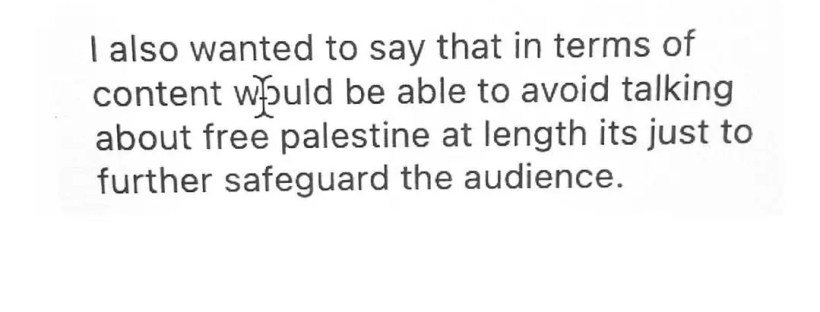
Artists for Palestine UK is shocked at reports that the Barbican told a Palestinian artist to avoid talking about freedom for Palestinians.
Having welcomed a co-founder of Palestinian station Radio Alhara to give a talk on “the radical nature of radio”, the Barbican reportedly instructed him to “safeguard the audience” by keeping his comments about Palestinian freedom to a minimum.
If the Barbican, a prestigious British arts institution, has engaged in such disgraceful anti-Palestinian racism and censorship, this raises urgent questions about the organisation’s commitment to freedom of expression and anti-discrimination.
The event was eventually cancelled due to “technical difficulties” – was this a flimsy cover for the Barbican’s anti-Palestinian censorship? Who authorised it?
Would the Barbican have told a Black South African artist decades ago to avoid talking “at length” about ending apartheid to protect the sensibilities of pro-apartheid audience members? If not, why the double standard?
Just a few months ago, fifty prominent artists and thousands of British people wrote to the Barbican urging the venue to end its partnership with the embassy of apartheid Israel.
The artists wrote, “today it is more than ever necessary for Israel to be held to account for its policies towards the Palestinian people – policies which are now widely recognised as fitting the United Nations’ definition of the crime against humanity of apartheid”.
The Barbican and any British arts institution that engages in anti-Palestinian racism and censorship may be liable to legal challenges. Instead of censoring Palestinians, arts organisations should be ending their own complicity in Israel’s apartheid regime.
 Artists for Palestine UK
Reblogged this on penelopap.
LikeLike
I totally agree, obviously. Who is pressuring the Barbican to behave in a his way and whom in the Barbican is allowing this to happen. May I suggest that these people are sought out and asked to comment on the record? I’d be happy to help with that.
LikeLike