Musicians Should Boycott Israel Until Palestinians Are Free

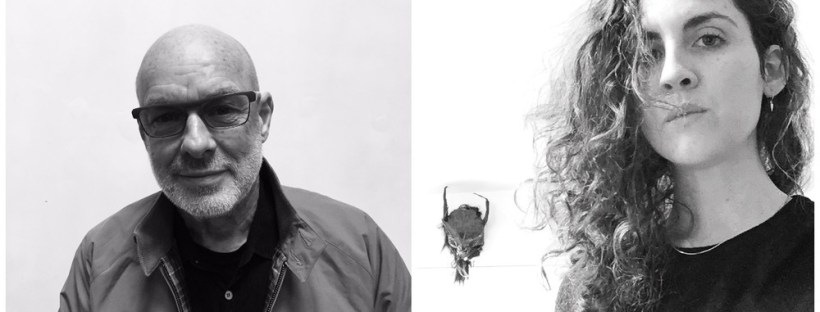
Musician Brian Eno, signatory of the UK Artists’ Pledge for Palestine, and Ohal Grietzer , a musician and activist with the Israeli group BOYCOTT! Supporting the Palestinian BDS Call from Within, made the following joint contribution to public discussion about the cultural boycott of Israel on Vice.com.

Continue reading

PACBI STATEMENT – Art should not be used to cover up apartheid: Boycott the Zabludowicz Art Trust!

The Palestinian Campaign for the Academic and Cultural Boycott of Israel (PACBI) has issued the following statement about the Zabludowicz  Art Trust.

pacbi logo

Art should not be used to cover up apartheid: Boycott the Zabludowicz Art Trust!

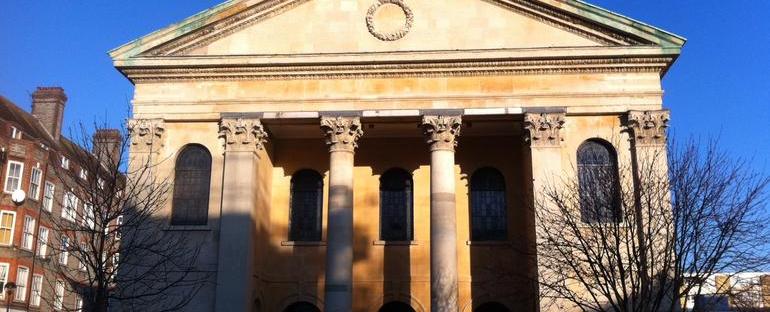
Occupied Palestine, October 26, 2015 — The Palestinian Campaign for the Academic and Cultural Boycott of Israel (PACBI) calls for a boycott of the Zabludowicz  Art Trust for its deep complicity in Israel’s regime of occupation, colonization and apartheid.

The Zabludowicz Art Trust directly supports Israel’s oppression of Palestinians through its funder, The Tamares Group, which is responsible for investments in Knafaim, an Israeli­-based holding company, focused on the aviation industry, with major holdings in several Israeli companies including Kanfey Tachzuka, which provides maintenance services to the Israeli Air Force[1], notorious for its ongoing commission of war crimes against Palestinian and Lebanese civilians. Continue reading

ARTISTS’ VERDICT – CULTURAL BRIDGES WITH ISRAEL LEAD NOWHERE

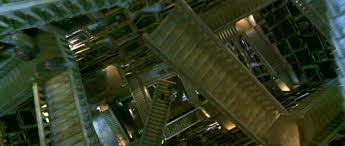
Like the staircases at Hogwarts, Israel's cultural bridges can lead interminably to nowhere

Like the staircases at Hogwarts, Israel’s cultural bridges can lead interminably to nowhere

The appearance last week of some famous UK cultural names on a statement defending Israel against boycott has sparked a wave of incredulity and outrage from fellow artists.

Artists, actors, writers, editors, musicians and filmmakers are among those queuing up to defend the boycott tactic after JK Rowling, Hilary Mantel and historian Simon Schama joined well-known pro-Israel lobbyists in attacking it. Rowling and co urged cultural ‘coexistence’ and ‘dialogue about Israel and the Palestinians’ and called the Palestinian boycott campaign “divisive and discriminatory”.

“It is Israeli policies towards Palestinians which are divisive and discriminatory,” said actress Miriam Margolyes, one of more than 1000 UK artists who have signed a commitment not to cooperate with Israeli state-funded cultural institutions as long as Palestinian rights are denied.
“Artists used the tactic of boycott against apartheid in South Africa and we are doing it again in support of Palestine– because no one else is holding Israel to account,” she said.

Composer Brian Eno, one of a number whose letters were published in the Guardian on October 27, said he appreciated the desire for dialogue, “but what kind of dialogue is realistically possible between a largely unarmed and imprisoned people whose land is disappearing before its eyes, and the heavily weaponised State that’s in the process of taking it.”  Continue reading

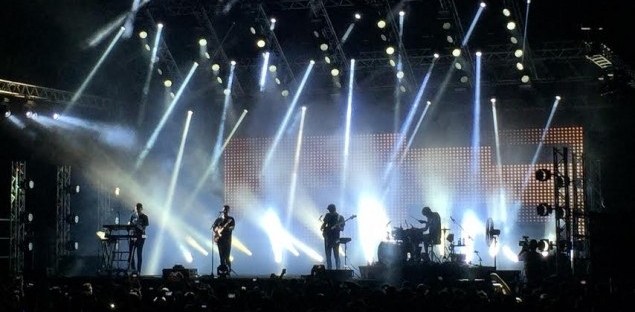
Brit band alt-J spurns Palestinian boycott, lifts spirits of Israel’s apartheid soldiers

This piece by Times of Israel founding editor David Horowitz perfectly demonstrates Israel’s desperate need for cultural nourishment from abroad to sustain its armed dominance over the Palestinian people.

The Indie band alt-J, from Leeds in northeast England, ignored weeks of appeals from pro-Palestinian campaigners and broke the boycott  to  play two nights in Rishon Lezion just south of Tel Aviv on August 23 and 24. Horowitz’s purple prose exalts the audience who had flocked to the concert as “young Israel — army kids and post-army kids and tomorrow’s army kids”.

Alt-J were providing much-needed R&R for the soldiers who had decimated Gaza a year earlier and will do so again if called upon. It would be hard to find a clearer justification for the Palestinian cultural boycott campaign urged upon those who wish to see an end to Israeli apartheid.  (For a more prosaic write-up, see this piece in the Jerusalem Post .)

“ISRAEL’S BEAUTIFUL YOUTH LIFTED BY THE GOSPEL OF ALT-J
An English band’s soaring harmonies strike a chord with the soldiers of a year ago and tomorrow. Continue reading

“Make Apartheid History” connects Palestine, South Africa and US civil rights

Artists for Palestine UK is proud to be a partner in this new initiative .

It’s time to ‘Make Apartheid History’ starting Mandela Day, Sat 18th July, 2015

Make Apartheid History, the follow-up to Bethlehem Unwrapped, launched online on Saturday 18th July, and we held our first event at London’s Southbank with a programme of poetry and prose linking civil rights, anti-apartheid, and Palestinian solidarity movements.Edited highlights of performances by Paterson Joseph, Miriam Margolyes, Kika Markham, Leila Sansour, Jeremy Hardy and Sam West are here.

Make Apartheid History is an international project that brings together creative individuals, organisations and networks from around the world – starting with Palestine and the UK; South Africa and USA – for a programme of popular events commencing summer 2015 and culminating Mandela Day, summer 2016. Our short introductory video is here. Continue reading

IRISH CAMPAIGNERS REJECT SMEARS AS DANCE FESTIVAL IN ISRAEL IS CANCELLED

Continue reading

I’m One Of 1000 UK Artists Boycotting Israel. Here’s Why

This thoughtful and informative piece by Samir Eskanda, one of the 1,050 signatories to the Artists’  Pledge for Palestine, first appeared on The Quietus.

Photo credit: Valerio Berdini

Photo credit: Valerio Berdini

As Thurston Moore, Miss Lauryn Hill and Primus become the latest to cancel shows in Tel Aviv, British-Palestinian musician Samir Eskanda makes the case for the boycott, with contributions from Moore and Jean-Hervé Peron of Faust.

In 2009, a couple of weeks after the end of Israel’s massacres in Gaza, dubbed “Operation: Cast Lead”, I decided to adopt the Palestinian call for boycotts, divestment and sanctions (BDS) against the state of Israel. The three-week assault, which served as the model for last summer’s rampage, was carried out on the pretext of ending erratic rocket fire from the besieged Gaza strip. In reality it represented an escalation of the daily violence committed by Israeli occupation forces against a relatively defenceless civilian population, themselves mostly refugees from previous rounds of aggression. Continue reading

Steffen Zillig’s diatribe in Das Kunstmagazin is wide of the mark

Earlier this month, a piece by artist and critic, Steffen Zillig appeared in the German Magazine, art – Das Kunstmagazine (‘The Art magazine’), where he is also editor. Zillig attacks the artists who in February signed a Pledge for Palestine. His piece contains no new charges worth refuting; however, the familiar antisemitism smear – delivered in a particularly aggressive tone – was given two further platforms, and unwarranted credibility, in the UK arts press: in Artlyst and Artnet, both of which failed to offer any analysis or counter-argument. That has been left to us. There is an English translation of the German article below our response to Zillig.

Zillig attributes various qualities to the signatories:

– They are not serious political activists: signing the Pledge is just the latest, clueless form of a fashion for art-activism. The signatories are assuming a role in a drama of their own making: David against Goliath, the dissident artist against the Leviathan state.
– They are ignorant of history, and simplify and moralise conflicts that are in reality complex and many-sided.
– They lack empathy for Israel, the only democracy in the Middle East, surrounded by states which have spurned every opportunity for peace.
– Unless and until all oppressive states are boycotted, a boycott of Israel is a signifier of antisemitism. (Deplorably, Zillig does not hesitate to impute antisemitic motives to individual artists.)

Zillig has constructed his polemic without, it seems, taking the trouble to read the ways in which the artists who have signed the pledge explain why they have done so.  Continue reading

Artists for Palestine UK Respond to JJ Charlesworth’s Criticism of the Cultural Boycott of Israel

Published at artnet News, Monday, March 2, 2015

In answering JJ Charlesworth’s broadside (See: The Cultural Boycott of Israel Isn’t Solidarity, It’s Condescension) against the Artists Pledge for Palestine, now signed by over 1000 British artists, we should start by recalling what the pledge actually says.

Those thousand artists, and more coming in all the time, say they will not accept professional invitations to Israel, nor funding, from any institutions linked to Israel’s government. This is not an act of “moral condescension by the self-righteous and self-regarding,” as Charlesworth alleges. It is a response to a call for boycott, divestment and sanctions (BDS) from across the whole of Palestinian civil society, including both individual artists and their representative organisations.

In an article that raises many common arguments against cultural boycott, but fails on nearly all counts to understand the position he is attacking, JJ. Charlesworth presents an unsustainable caricature of the motives and actions of artists and cultural workers who’ve signed the pledge. He makes some points that are serious and deserve serious answers. But there is a morass of soft thinking and loose argument to clear out of the way first. Continue reading

Responding to the ‘Challenging Double Standards’ anti-boycott call

A week before we launched the artists’ pledge, Artleaks published a call by a group calling themselves Challenging Double Standards (CDS), arguing against what they term ‘the Boycott of Israeli Art and Society.’ You can read their call here. Subsequent to our launch, some of the UK arts press linked to the CDS call in their coverage of the artists’ pledge. APUK felt it necessary to publish a response – together with Israeli citizens for BDS – which Artleaks agreed to post on their website. You can also read it in full below:

On 13th February, Artists for Palestine UK launched the Artists’ Pledge for Palestine, which now has more than 1,000 signatories. In its first week, the website received over 160,000 hits; it seems fair to say that its launch has opened another phase in the debate about the response that cultural workers can make to the struggle of Palestinians against oppression.

Another contribution to these arguments – strongly opposed to ours – has been made by a group of cultural workers based mainly in Germany. Published in ArtLeaks a few days before we launched the Artists’ Pledge for Palestine, it comprises a call against boycott, made under the heading ‘Challenging Double Standards.’In the interests of debate, we offer a summary of what we take to be the authors’ main propositions, followed by a defence of our own approach and a critique of theirs.

Continue reading

The response from Israel: ‘cheap propaganda’ & hate-filled satire

The antisemitism smear was the anticipated response of Israel’s apologists to the artists’ pledge for human rights. Indeed that is what makes signatories courageous individuals. What was feared but less anticipated was the extent to which that smear would be sharpened – and then given a platform in the mainstream press – to hold pledge signatories responsible for the deadly targeting of Jews.

Continue reading

Palestinian artists speak: boycott directed against apartheid system of occupation & discrimination

My name is Abdelfattah Abusrour. I am director of Alrowwad cultural and theatre training society, which I founded with a group of friends in 1998 in Aida refugee camp in Bethlehem, Occupied Palestine, where I was born, to create a safe space of beautiful expression, a philosophy that I call beautiful resistance against the ugliness of occupation and its violence… and to help our children and youth to see their potential as change makers, without needing to carry a gun and shoot everybody else…

In May 2002, Alrowwad theatre centre was vandalised by the Israeli army. They broke our video cameras and computers, and emptied oil and acrylic painting tubes all over the space. During our tours in the West Bank, many checkpoints forbid us passage with our theatre or dance shows and our play bus. We wait for hours, sometimes without being allowed to pass south to Hebron or to the north. No access is granted to Gaza, to East Jerusalem or 1948 Palestine.

Theatre and arts are about giving a voice to those who are not heard, and defending what we believe is just and right… That is why for me as an artist, as a theatre practitioner, I boycott every relation with Israeli artists or academics or politicians… Continue reading

Is this the Guardian’s notion of balance?

In the week following the publication of our letter announcing the launch of the artists’ pledge, the Guardian published several responses – on the letters page, and in Comment is Free (CiF). Of nine published letters, three were supportive. Our riposte (below) went unpublished. Novelist Kamila Shamsie’s piece on why she signed the pledge was easy to miss: it appeared only in the print edition, under ‘The week in Books’.

Unusually, an Israeli politician was given a slot in both sections of the newspaper. On the same day, a CiF piece appeared entitled ‘Those calling for a boycott of Israel are ignoring some painful truths‘, as well as a letter under the sensationalist and inflammatory headline, ‘Why no petition to protect Jewish people?‘. The author, chairperson of the Yesh Atid party, Yair Lapid, was even permitted to repeat his hasbara, so that Guardian readers are subjected twice to his derisory hyperbole suggesting an inevitable genocide of Israeli Jews would be on the consciences of the pledge signatories:

As artists – who by definition are people with imagination – are they willing to take a moment and consider what would happen if, following a call in the Guardian, the IDF puts down its weapons and stops protecting the people of Israel for 24 hours? If you don’t share the imagination of an artist let me tell you: radical Islamists would kill us all. Women and children first.

Continue reading

Theatre director Jonathan Chadwick: BDS crucially important element in resistance

Jonathan Chadwick – artistic director of Az Theatre, and a Pledge signatory – has written a blog post about his recent trip to the West Bank, which we think is worth sharing:

I went to Palestine on Saturday 7th February and came back on Sunday 15th February. I failed to get into Gaza to pursue the work on War and Peace.

Caryl Churchill and I worked on her recent play, Love and Information, at Ashtar Theatre. The British Council accommodated us. The Royal Court Theatre provided finance for the translation. We paid for the travel and did the work for free. It was our contribution, like planting a play in Palestine! Continue reading

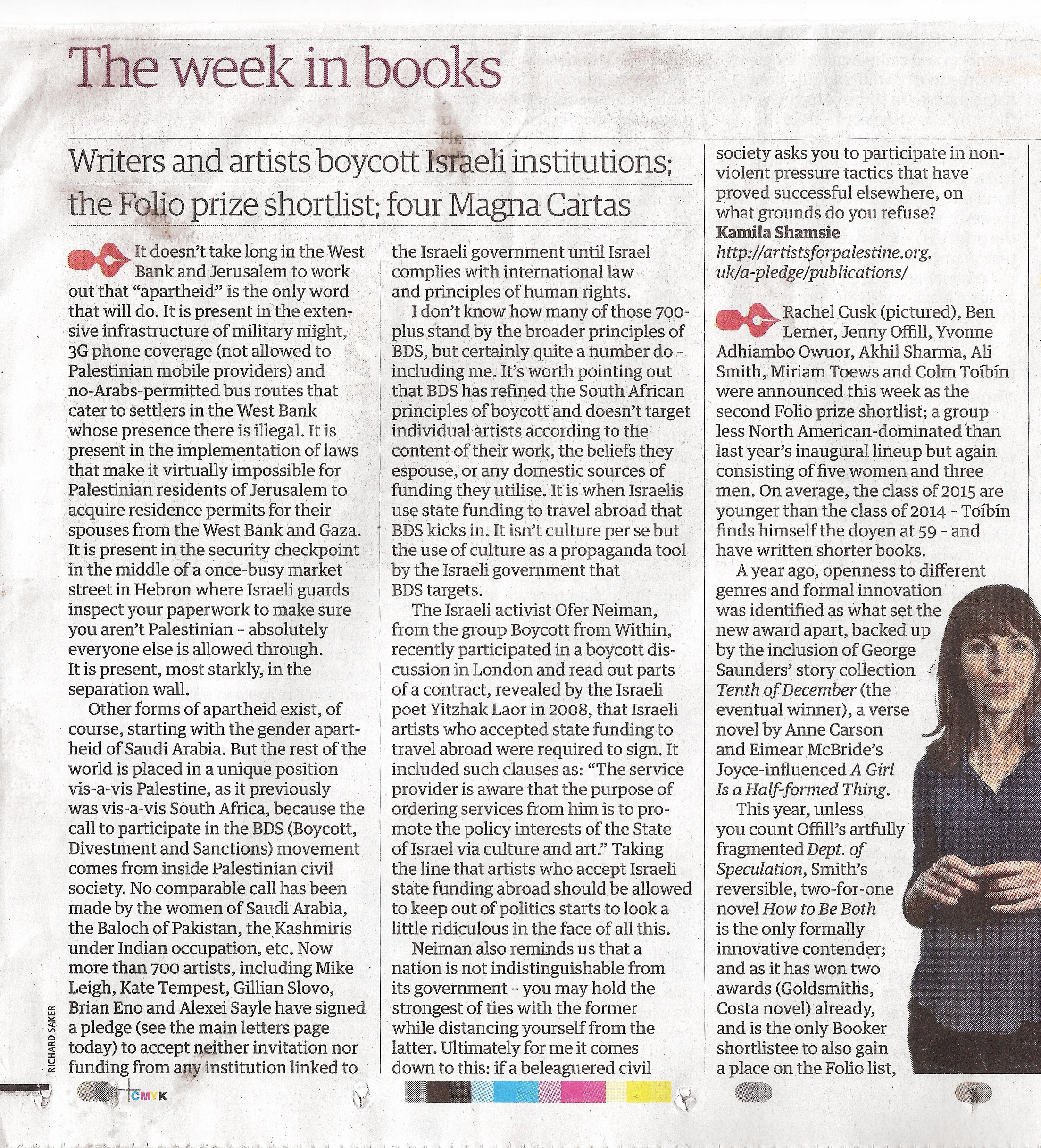
Kamila Shamsie: Why I signed the artists’ pledge for Palestine

On Saturday 14 February, a 600 word piece was published in the Guardian Saturday Review by novelist and pledge signatory, Kamila Shamsie, which we reproduce in full here:

Kamila Shamsie 14.02.15It doesn’t take long in the West Bank and Jerusalem to work out that ‘apartheid’ is the only word that will do. It is present in the extensive infrastructure of military might, 3G phone coverage (not allowed to Palestinian mobile providers), and no-Arabs-permitted bus routes that cater to settlers in the West Bank whose presence there is illegal. It is present in the implementation of laws that make it virtually impossible for Palestinian residents of Jerusalem to acquire residence permits for their spouses from the West Bank and Gaza. It is present in the security checkpoint in the middle of a once-busy market street in Hebron where Israeli guards inspect your paperwork to make sure you aren’t Palestinian – absolutely everyone else is allowed through. It is present, most starkly, in the Separation Wall. Continue reading

Guardian: Our cultural boycott of Israel starts now

Guardian letters
Friday 13 February

Along with more than 600 other fellow artists, we are announcing today that we will not engage in business-as-usual cultural relations with Israel. We will accept neither professional invitations to Israel, nor funding, from any institutions linked to its government. Since the summer war on Gaza, Palestinians have enjoyed no respite from Israel’s unrelenting attack on their land, their livelihood, their right to political existence. “2014,” says the Israeli human rights organisation B’Tselem, was “one of the cruellest and deadliest in the history of the occupation.” The Palestinian catastrophe goes on. Israel’s wars are fought on the cultural front too. Its army targets Palestinian cultural institutions for attack, and prevents the free movement of cultural workers. Its own theatre companies perform to settler audiences on the West Bank – and those same companies tour the globe as cultural diplomats, in support of “Brand Israel”. During South African apartheid, musicians announced they weren’t going to “play Sun City”. Now we are saying, in Tel Aviv, Netanya, Ashkelon or Ariel, we won’t play music, accept awards, attend exhibitions, festivals or conferences, run masterclasses or workshops, until Israel respects international law and ends its colonial oppression of the Palestinians.

To see the full list of supporters, go to artistsforpalestine.org.uk. Khalid Abdalla, Riz Ahmed, Peter Ahrends, Hanan Al-Shaykh, Will Alsop, Richard Ashcroft, John Berger, Bidisha, Nicholas Blincoe, Leah Borrromeo, Haim Bresheeth, Victoria Brittain, Niall Buggy, Tam Dean Burn, Jonathan Burrows, David Calder, Anna Carteret, Taghrid Choucair-Vizoso, Ian Christie, Caryl Churchill, Sacha Craddock, Liam Cunningham, Selma Dabbagh, Colin Darke, April De Angelis, Andy de la Tour, Ivor Dembina, Shane Dempsey, Elaine Di Campo, Patrick Driver, Earl Okin, Sally El Hosaini, Brian Eno, Gareth Evans, Annie Firbank, James Floyd, Aminatta Forna, Jane Frere, Kadija George, Bob Giles, Mel Gooding, Tony Graham, Omar Robert Hamilton, Jeremy Hardy, Mike Hodges, James Holcombe, Rachel Holmes, Adrian Hornsby, Rose Issa, Ann Jungman, John Keane, Brigid Keenan, Hannah Khalil, Shahid Khan, Peter Kosminsky, Hari Kunzru, Paul Laverty, Alisa Lebow, Mike Leigh, Tom Leonard, sonja Linden, Phyllida Lloyd, Ken Loach, Liz Lochhead, David Mabb, Sabrina Mahfouz, Miriam Margolyes, Kika Markham, Simon McBurney, Sarah McDade, Jimmy McGovern, Pauline Melville, Roger Michell, China Mieville, Russell Mills, Laura Mulvey, Jonathan Munby, Courttia Newland, Lizzie Nunnery, Rebecca O’Brien, Treasa O’Brien, Andrew O’Hagan, Jeremy Page, Timothy Pottier, Michael Radford, Maha Rahwanji, Ravinder Randhawa, Siobhan Redmond, Lynne Reid Banks, Ian Rickson, Leon Rosselson, Kareem Samara, Leila Sansour, Alexei Sayle, Seni Seneviratne, Kamila Shamsie, Anna Sherbany, Eyal Sivan, Gillian Slovo, John Smith, Max Stafford-Clark, Maggie Steed, Sarah Streatfeild, Mitra Tabrizian, Mark Thomas, Cat Villiers, Roger Waters, Esther Wilson, Penny Woolcock, Susan Wooldridge, Emily Young, Andrea Luka Zimmerman